He had seven minutes.
Seven minutes to convince a room of twelve partners at a Zurich venture fund that his biotech company was worth €8 million. He'd spent three weeks on the deck. Forty-two slides. Every data point was airtight.
He opened with slide one: company history. Slide two: team bios. Slide three: market overview. By slide four, the partner at the head of the table was checking her phone.
He didn't get the round.
When he came to me, I asked him to walk me through his opening. He did. And the problem was obvious within fifteen seconds.
He'd given them a structure. But not a story.
Most executives and founders make this same mistake. They think structure and story are the same thing. They're not. Structure is how you organise information. Story is how you make someone care about it. You need both. But you need to know which tool to reach for and when.
There are dozens of storytelling frameworks out there. Most of them overlap. Some are brilliant. Some are unnecessary. And most leaders have never been taught any of them, so they default to bullet points and hope for the best.
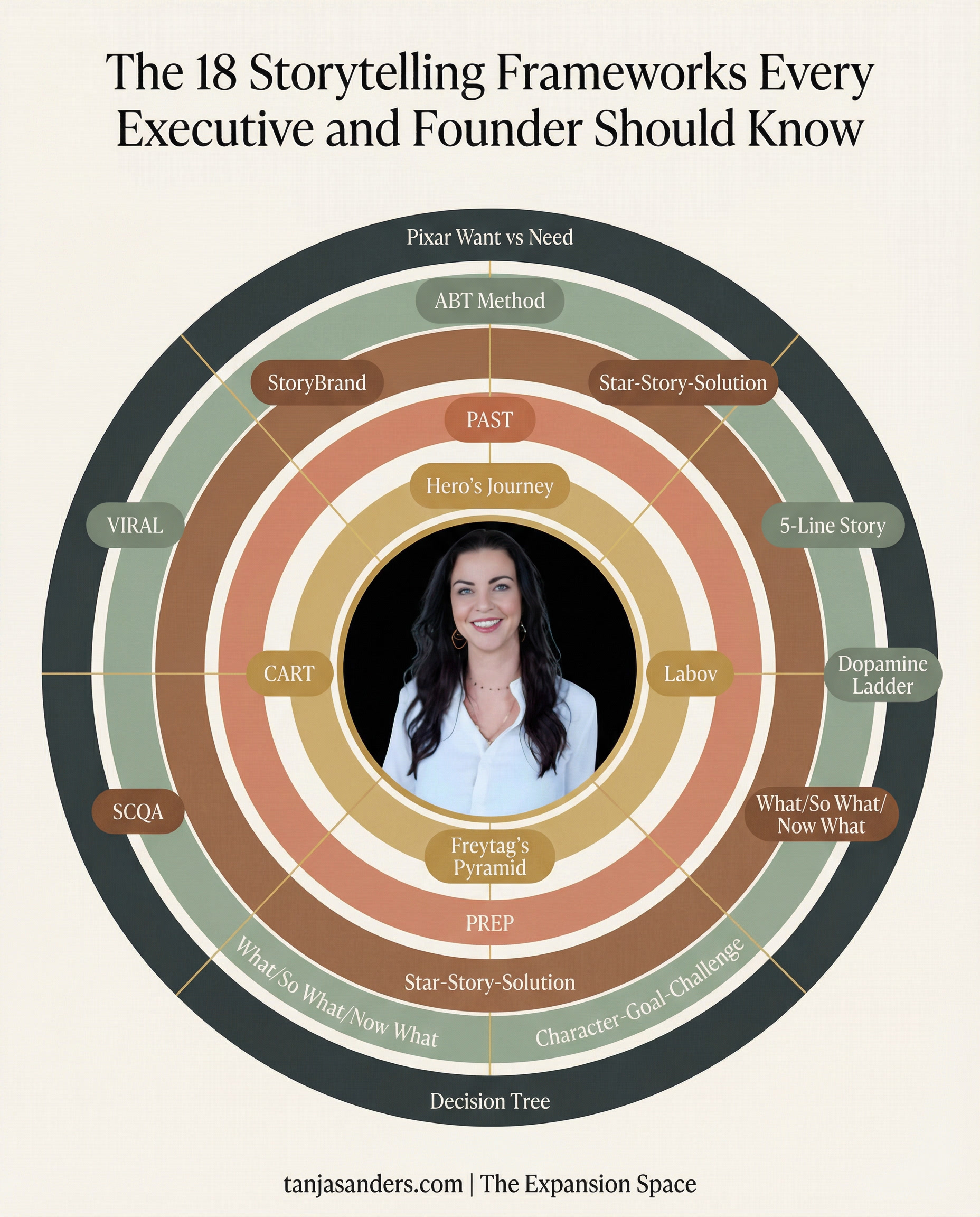
Here's the complete guide. Eighteen frameworks, organised by what they're for. Save this. Come back to it. And the next time you need to move a room, you'll know exactly which tool to pick up.
Table of Contents
Part 1: The Ancient Structures
1. The Hero's Journey (Joseph Campbell)
2. Freytag's Pyramid (Aristotle / Gustav Freytag)
3. Labov's Narrative Framework (William Labov)
Part 2: The Quick-Draw Frameworks
4. CART: The Two-Minute Story
5. PAST: Making Any Scene Come Alive
6. PREP: When You're Put on the Spot
7. What? So What? Now What?
Part 3: The Boardroom and Pitch Frameworks
8. SCQA + The Pyramid Principle (Barbara Minto)
9. The StoryBrand Framework (Donald Miller)
10. Star-Story-Solution
11. Character-Goal-Challenge
Part 4: Content and Social Media Frameworks
12. VIRAL (Jenny Hoyos)
13. The ABT Method (Trey Parker & Matt Stone)
14. The 5-Line Story Method
15. The Dopamine Ladder
Part 5: The Psychological Frameworks
16. Pixar's Want vs Need
17. Will Storr's Theory of Control
Bonus
18. The Framework Decision Tree
The Framework Is Never the Point
Part 1: The Ancient Structures
These are the foundations. Every modern framework is a variation on one of these three.
1. The Hero's Journey (Joseph Campbell)
Joseph Campbell studied thousands of myths across cultures and found they all follow the same arc. A person leaves the known world, faces trials and a confrontation with something larger than themselves, and returns transformed. He called it the Monomyth.
The structure moves through three stages: Separation (leaving the familiar), Initiation (facing the dragon), and Return (coming back with wisdom or a gift for the community).
George Lucas used this structure to build Star Wars. Christopher Nolan used it for Batman. Every origin story you've ever loved, whether it's a film or a founder pitch, follows some version of this arc.
For leaders, the Hero's Journey matters because it reveals something fundamental about how humans process change. We don't remember the data about a transformation. We remember the person who went through it. If your company story doesn't have a clear departure, a real struggle, and a visible return, the audience has nothing to hold onto.
The problem? It's too long for most business contexts. You can't run a twenty-minute monomyth in a seven-minute pitch. That's why the shorter frameworks exist. But knowing this structure is like knowing the grammar of your language. You don't always diagram a sentence, but you write better because you can.
.jpg?width=2048&height=2048&name=gemini-image-2_Elegant_circular_infographic_showing_the_Hero_s_Journey_as_a_clockwise_loop_with-0%20(1).jpg)
2. Freytag's Pyramid (Aristotle / Gustav Freytag)
Aristotle argued that every great story needs a beginning, a middle, and an end. Two thousand years later, Gustav Freytag mapped this into a five-act structure that became the backbone of Western drama: exposition, rising action, climax, falling action, and resolution.
The key insight Aristotle gave us is the concept of peripeteia, the reversal of fortune. The moment where the action swings to its opposite. The protagonist was winning, now they're losing. They were certain, now they doubt everything.
In business storytelling, peripeteia is the most powerful weapon you have. It's the moment in your pitch where the audience's assumption gets flipped. "We thought the problem was customer acquisition. It wasn't. The problem was that we were acquiring the wrong customers." That reversal is what makes the room sit up.
If your story doesn't have a turning point, it's not a story. It's a timeline.

3. Labov's Narrative Framework (William Labov)
William Labov studied how ordinary people tell stories in conversation and found that every well-told oral narrative contains six parts: an Abstract (what's this about?), Orientation (the who/what/where/when), Complication (what went wrong), Evaluation (why it matters), Resolution (how it ended), and a Coda (bringing the listener back to the present).
The part most people skip is the Evaluation. They tell you what happened. They don't tell you why it mattered. And without the "so what," even a great story leaves the audience thinking: okay, but why are you telling me this?
Labov's framework is especially useful for personal stories in interviews, keynote openings, and podcast appearances. Any time you're telling a story about yourself, run it through these six checkpoints. If any piece is missing, the story will feel incomplete, even if the listener can't articulate why.

Part 2: The Quick-Draw Frameworks
These are the tools for everyday business communication. Two-minute stories, impromptu responses, status updates. The moments that happen ten times a week and shape how people perceive you.
4. CART: The Two-Minute Story
Context, Adversity, Resolution, Takeaway. This is the framework I teach first to every founder and executive in The Expansion Space, because it solves the most common storytelling problem: knowing how to tell a short, clear story with a point.
Context is the scene. Two sentences. Where are you? What's happening?
Adversity is the conflict. The thing that went wrong, the obstacle, the moment of tension. Without adversity, there's no story. There's just an update.
Resolution is what you did. Not where you looked like a genius. Where you looked human.
Takeaway is the lesson. Phrased as "What I learned from that is..." One sentence. Clean.
For social media, compress it to CAT: Context, Adversity, Takeaway. Drop the resolution, keep the pace fast, let the lesson land before anyone has time to scroll.
If you can't tell a two-minute CART story about why your company exists, no pitch deck in the world will save you.

5. PAST: Making Any Scene Come Alive
CART gives you the architecture. PAST gives you the texture. It stands for Place, Actions, Speech, Thoughts.
Most business storytellers summarise: "I had a tough meeting with the board." That's a headline, not a scene. PAST teaches you to zoom in.
Place is the physical location. Not "at a meeting." But "in a glass conference room on the ninth floor, with the rain coming sideways against the window."
Actions are what you're physically doing. "I'm staring at the projector, waiting for my slides to load."
Speech is direct dialogue. Not "she told me she was concerned." But: "She looked at me and said, 'We don't have six months. We have six weeks.'"
Thoughts are your internal monologue. The raw, unfiltered thing running through your head. "My first thought was: we're going to lose this account."
You don't use PAST for the whole story. You use it to zoom in on the one scene that matters most. The thirty seconds that changed everything.

6. PREP: When You're Put on the Spot
Point, Reason, Example, Point.
Someone asks your opinion in a board meeting. A journalist calls. An investor at dinner says, "So what's your take on the market?"
PREP keeps you from rambling. State your point. Give the reason. Share one specific example. Restate the point. The bookend gives your answer completeness. You sound considered, not scripted. Decisive, not rehearsed.
The executives I coach who use PREP consistently tell me the same thing: they stop dreading being put on the spot. Because they have a reliable structure their brain can grab in the moment. And the people around them notice.
.jpg?width=1856&height=2304&name=gemini-image-2_Infographic_showing_three_large_overlapping_circles_in_a_horizontal_Venn_diagram-0%20(1).jpg)
7. What? So What? Now What?
No acronym. No cleverness. Just the most useful communication framework for the task leaders face most often: explaining what just happened and what to do about it.
What happened. So what does it mean. Now what do we do.
This works for crisis comms, team updates, investor emails, Slack messages, and the moment after a deal falls through when your team is staring at you.
A variation for longer updates: Past, Present, Future. Where we were, where we are, where we're going. Same principle, different rhythm.

Part 3: The Boardroom and Pitch Frameworks
These frameworks are built for high-stakes persuasion. Investor meetings, board presentations, strategy proposals. Contexts where the audience is senior, time-poor, and deciding whether to give you money or authority.
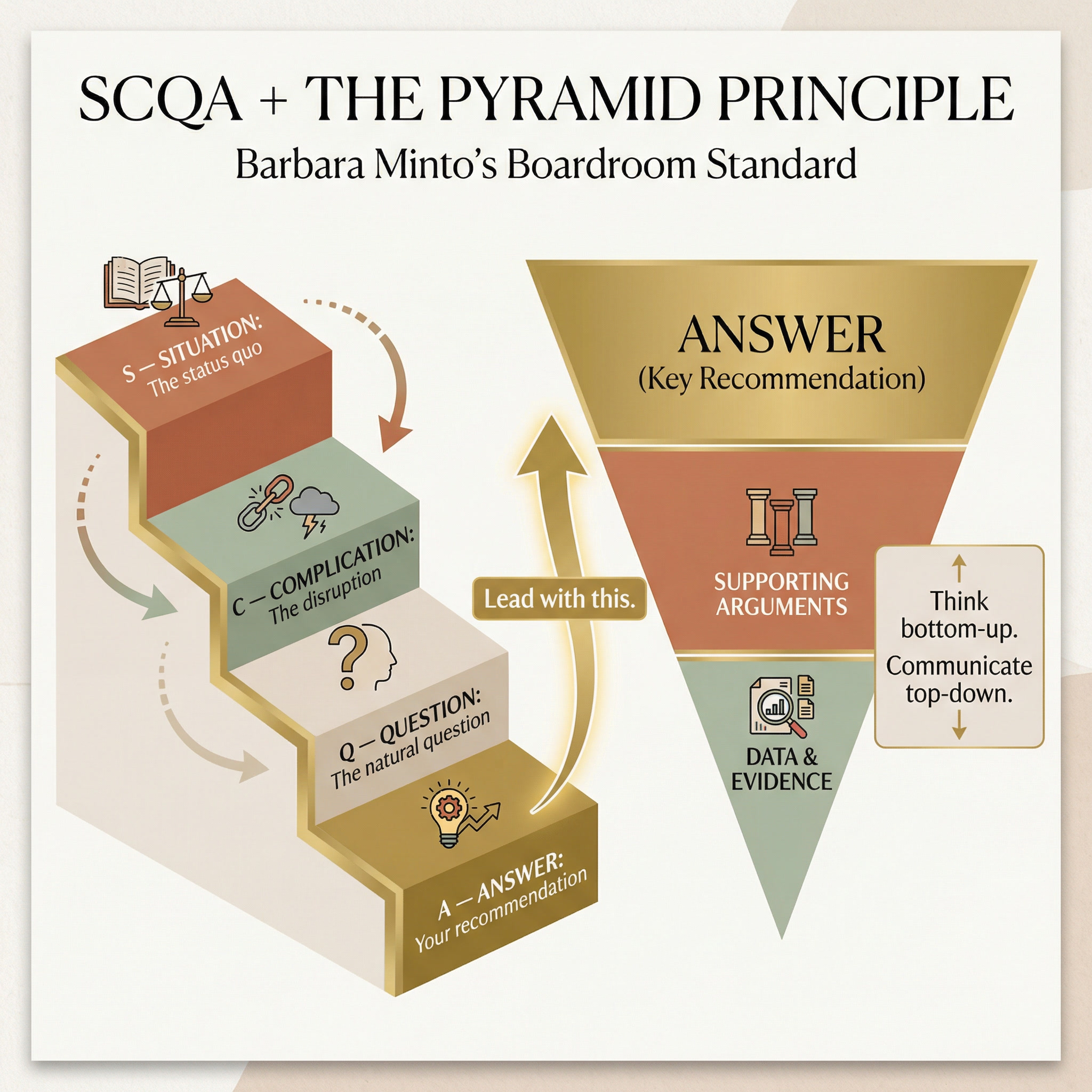
8. SCQA + The Pyramid Principle (Barbara Minto)
Barbara Minto was the first woman hired by McKinsey out of an MBA programme. In the 1970s, she noticed that brilliant consultants kept losing the room in the first five minutes. They'd start with the research. The methodology. The background. By the time they got to the recommendation, the audience had checked out.
So she built SCQA. And it became the standard at McKinsey, Bain, BCG, and nearly every consulting firm on the planet.
Situation: the context the audience already knows. The shared status quo.
Complication: the disruption. The tension. The thing that changed.
Question: the natural question that arises from the complication.
Answer: your recommendation. Led with first, not saved for last.
Minto's Pyramid Principle works the same way: answer at the top, supporting arguments below, data at the base. Most people build to their conclusion. Executives want the conclusion first.
When I work with founders preparing for board presentations, we almost always rebuild the deck using SCQA. The information doesn't change. The order does. And the response in the room changes completely. Instead of polite nods and "let us circle back," you get follow-up questions. Engagement. The lean-in.
Every boardroom story needs a complication. Without it, you're not telling a story. You're giving a status report.
9. The StoryBrand Framework (Donald Miller)
Donald Miller built StoryBrand on one insight: companies keep making themselves the hero of their own story. But the customer is the one with the problem, the fear, and the desire. The customer is the hero. The brand should be the guide.
His framework has seven beats:
A Character (the customer) has a Problem. A Guide (your brand) enters the picture with empathy and authority. The Guide gives a Plan. And Calls them to Action. That action leads to Success (if they engage) or Failure (if they don't).
The key insight is positional. You're not Luke Skywalker. You're Yoda. You're not the one on the quest. You're the one who's already been there and holds the map.
I wrote about this in depth in a previous post, but it bears repeating here because it's the most common storytelling mistake I see in founder pitches and executive brand narratives. The moment you flip from hero to guide, everything in your communication changes.

10. Star-Story-Solution
A clean copywriting formula that works for case studies, sales pages, and investor updates.
Star: the person who achieved the desired result. Your customer, your client, your case study.
Story: the struggle and pain they went through before. This is where you illuminate the problem so vividly that the audience recognises their own situation.
Solution: how your product, service, or approach created a new reality.
The power of Star-Story-Solution is that it forces you to lead with a person, not a product. The audience connects to the human first. The solution feels earned because they felt the struggle.

11. Character-Goal-Challenge
The simplest framework for business anecdotes. When you need to tell a quick story in a presentation and you don't want it to sound like a list of facts:
Give us a Character (a specific person). Tell us their Goal (what they were trying to achieve). Show us the Challenge (what stood in the way). The resolution is implied or stated briefly.
This works brilliantly for the middle of a presentation when you need to humanise a data point. "Our customer Maria was trying to reduce her team's onboarding time from three weeks to one. The challenge was that their existing system had no automation. Here's what happened when she switched."
That's infinitely more engaging than "Customer retention improved by 34%."

Part 4: Content and Social Media Frameworks
These are built for the feed, the scroll, and the algorithm. Short-form video, LinkedIn posts, YouTube scripts.
12. VIRAL (Jenny Hoyos)
Developed by viral content creator Jenny Hoyos for short-form video.
Visual Shock: something that stops the scroll in the first half-second.
Immediately Start: skip the intro. Skip the context. Jump into the tension.
Rising Action: state the problem or question the piece will resolve.
Anticipation: tease the answer without revealing it. This is what keeps someone watching past fifteen seconds.
Lasting Payoff: deliver the answer. Make it concise, satisfying, and worth the wait.
For my clients building visibility on LinkedIn or creating video content, I combine VIRAL for the opening with CART for the structure underneath. That combination is what separates content that performs from content that connects.
.jpg?width=2048&height=2048&name=gemini-image-2_Infographic_showing_a_vertical_smartphone_screen_outline_with_five_horizontal_se-0%20(1).jpg)
13. The ABT Method (Trey Parker & Matt Stone)
Trey Parker and Matt Stone, the creators of South Park, have a rule: every story beat should connect with "but" or "therefore," never "and then."
"And then" is a grocery list. It's the structure of a boring story. "I went to the store and then I went home and then I made dinner." Nothing happens. There's no tension. No cause and effect.
ABT replaces that with a causal chain:
And: sets the context. "We had a great product and strong early traction."
But: introduces the conflict. "But our customer acquisition costs were three times our target."
Therefore: the consequence. "Therefore we had to completely rethink our go-to-market."
This tiny structural shift transforms any sequence of events into a story. And it's especially powerful for LinkedIn posts and short updates where you need tension in a small space.

14. The 5-Line Story Method
A minimalist blueprint for creators who need an emotional arc without overcomplicating it:
1. Situation: the starting point. 2. Desire: what the character wants. 3. Conflict: what gets in the way. 4. Change: the turning point. 5. Result: the new reality.
Five lines. That's a LinkedIn post. That's a sixty-second video. That's the opening of a keynote. The constraint forces you to find the emotional core and cut everything else.

15. The Dopamine Ladder
A framework for keeping attention in digital content by cycling through four psychological triggers:
Stimulation: a visual or sensory hook that wakes the brain up.
Captivation: a curiosity-inducing question. Something the audience now needs the answer to.
Anticipation: delaying the answer. Building the tension. Giving hints without resolution.
Validation: closing the loop. Delivering the answer. The dopamine hit that rewards the audience for staying.
This isn't a story structure. It's an attention architecture. And it maps perfectly onto the first thirty seconds of any video, presentation, or pitch. The Dopamine Ladder explains why some openings work and others don't: the audience's brain needs each trigger in sequence.

Part 5: The Psychological Frameworks
These go deeper than structure. They explain why stories create emotional change in the first place.
16. Pixar's Want vs Need
Pixar doesn't just tell stories. They build emotional arcs that make grown adults cry in animated films about toys and robots. Their secret is a framework built on internal contradiction.
Every great character wants something (an external goal) but needs something different (an internal truth). The story is the collision between the two.
Lightning McQueen wants to be the fastest car in the world. He needs to learn that speed without connection is meaningless. Woody wants to be Andy's favourite toy. He needs to learn that love isn't about being first.
For leaders, this framework unlocks the most compelling layer of personal storytelling. You wanted the promotion. You needed to learn that visibility mattered more than output. You wanted to close the round. You needed to learn that the story was more important than the deck.
When you find the gap between what you wanted and what you actually needed, you've found the story that moves people. Because every person in the audience has their own version of that gap.

17. Will Storr's Theory of Control
Will Storr argues that every compelling character begins with a flawed theory of control: a specific belief about how they keep their world safe. "I am only safe if I am wealthy." "I am only worthy if I am perfect." "I am only valued if I am productive."
The story acts as a stress test. It puts that belief under so much pressure that it breaks. And the character is forced to change who they are at a fundamental level to survive or succeed.
This is the framework that explains why vulnerability works in leadership storytelling. When you share the belief that used to run your life and the moment it broke, the audience doesn't just understand your story. They feel it. Because they have their own theory of control. And hearing someone else's crack open gives them permission to question theirs.
In The Expansion Space, this is the layer we work on most. Not what happened to you. But what you believed about the world before it happened, and what you believe now. That's where the real story lives.

18. The Framework Decision Tree: How to Choose
Telling a two-minute story in person? Use CART. Add PAST to zoom in on the key scene.
Put on the spot for your opinion? Use PREP.
Writing a LinkedIn post or short-form content? Use the 5-Line Story or ABT for structure. Use VIRAL or the Dopamine Ladder for the hook.
Pitching to investors or presenting to the board? Use SCQA for the structure. Use CART for the opening story. Use StoryBrand to make sure the customer is the hero.
Writing a sales page or case study? Use Star-Story-Solution or Character-Goal-Challenge.
Telling your origin story on a stage or a podcast? Use the Hero's Journey as the arc. Use PAST to bring the key scenes alive. Use Pixar's Want vs Need to find the emotional core.
Building a personal narrative for visibility? Use Storr's Theory of Control to find the belief that broke. Use Labov's framework to make sure the story is structurally complete.
Giving a status update or explaining a crisis? Use What/So What/Now What.
No single framework does everything. The skill is in knowing which one to reach for and when.

The Framework Is Never the Point
Here's what I tell every client inside The Expansion Space: frameworks don't make you a storyteller. They make you organised. Which is necessary but insufficient.
The real work is underneath. Finding the story that only you can tell. The one with a real turning point, a real cost, and a real lesson. The frameworks give that story a vehicle. But the story has to exist first.
The founder in Zurich? We rebuilt his entire pitch using SCQA for the structure and CART for the opening. He led with a sixty-second story about a patient named Claudia whose diagnosis was delayed by eleven days because of the exact problem his technology solves. Then he said: "That's the complication. Here's how we fix it."
He raised his round six weeks later.
The deck had the same data. The slides had the same charts. The only thing that changed was the order in which the room felt things.
Structure without story is a spreadsheet. Story without structure is a ramble. You need both. And now you know which tool to reach for.

→ Join The Expansion Space and build the narrative your audience actually remembers.